A storm does not wait for your accountant to catch up. It does not care whether you filed an extension. Understanding the Qualified Disaster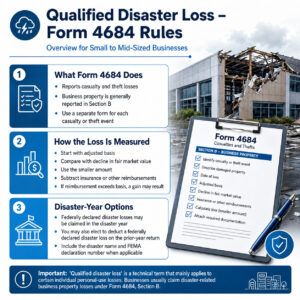 Loss Form 4684 Rules decides how much of that damage your business can recover through the tax code, and most owners never read them until the damage is already done.
These tax provisions allow a business owner to report property damage tied to a federally declared disaster and claim a deduction that lowers taxable income for that year. Following these steps also opens a faster path to relief for owners who need cash sooner rather than later.
What the Qualified Disaster Loss Form 4684 Rules Cover
A casualty loss happens when your property is damaged, destroyed, or stolen because of a sudden event like a flood, fire, tornado, or earthquake. A qualified disaster loss is a specific type of casualty loss tied to a disaster the federal government has officially declared.
Business owners report business or income-producing property in Section B of Form 4684. Unlike personal casualty losses, business property losses are not subject to the 10 percent adjusted gross income limitation or the 100 dollar reduction. Knowing the Qualified Disaster Loss Form 4684 Rules ensures you correctly calculate the loss using the property’s adjusted basis, subtracting any salvage value and insurance reimbursements.

Property Asset Types and Reporting Methods
The method you use to claim a loss depends heavily on the type of business property that was damaged.
| Property Type | Tax Treatment | Form Used | Key Requirement |
|---|---|---|---|
| Fixed Assets and Real Property | Business Casualty Loss | Form 4684 (Section B) | Requires FEMA declaration number and basis proof |
| Inventory | Cost of Goods Sold (COGS) Adjustment | Schedule C or Corporate Return | Adjust opening and closing inventory figures |
Form 4684 is built for depreciable business assets, real property, and equipment. It is not the form for lost or damaged inventory. When a disaster destroys inventory, you handle that loss directly through cost of goods sold by adjusting your opening and closing inventory figures.
Critical Tax Details That Affect Your Deduction
A few technical details can impact your overall tax return when navigating these situations:
- You must file a timely insurance claim before taking the deduction, as the IRS disallows losses up to the covered amount if you skip filing to prevent premium increases.
- Any reimbursement you receive or expect to receive reduces your deductible loss dollar for dollar.
- If reimbursements exceed your adjusted basis, the excess becomes a taxable gain unless deferred by reinvesting in replacement property.
- You have the option to deduct the loss on the prior year’s tax return to receive a faster refund, making the Section 165 election within six months of your return’s original due date.
Required Records to Gather Before Filing
Good documentation turns a tax claim into an approved deduction. Collect these files before filing:
- FEMA disaster declaration number for your area
- Insurance claim filings, settlement statements, or formal denial letters
- Repair estimates, contractor invoices, and before-and-after photographs
- Purchase records and depreciation schedules showing original cost basis
Common Errors to Avoid
Applying the Qualified Disaster Loss Form 4684 Rules correctly requires avoiding several frequent mistakes:
- Forgetting to include the official FEMA disaster declaration number
- Confusing Section A personal property rules with Section B business property rules
- Reporting inventory losses on Form 4684 instead of adjusting cost of goods sold
- Failing to reduce the claim by expected insurance reimbursements
- Waiting until the tax extension deadline to compile documentation
Take Action On Your Business Casualty Loss
Navigating disaster recovery rules can be complex, and missing key election windows or miscalculating asset basis can cost your business thousands of dollars. Do not navigate the recovery process alone. Contact us today to review your documentation, calculate your deductible loss, and secure every tax advantage available for your business.