 Storms do not wait for tax season. After the severe storms and flooding that began on August 11, 2026, individuals and business owners across Indiana, Illinois, and Michigan want a clear answer. Does the IRS tax relief August 2026 storm extension Indiana, Illinois, Michigan really help you? The answer is yes, but rules vary by state.
This guide breaks down what changed, who qualifies, and what steps every taxpayer should take next.
What Happened After the August 2026 Storms
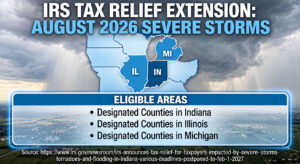
Severe storms, high winds, tornadoes, and flooding hit the region starting August 11, 2026. The damage was serious enough that FEMA declared a major disaster for parts of Indiana, including Lake, Porter, and LaPorte counties (see IRS Notice IN-2026-01). This declaration is what opens the door to federal tax relief for individual taxpayers, self employed workers, and businesses alike.
Illinois and Michigan also have their own storm related tax relief programs, but they work in different ways. That is why taxpayers in these three states are seeing different answers online, and why it matters to check the exact rules for your state.
How the Relief Works in Indiana
The IRS issued Notice IN 2026 01 on September 2, 2026. This notice gives disaster relief to taxpayers in the FEMA declared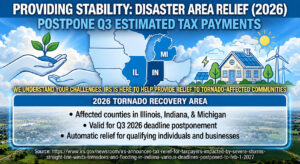 Indiana counties. It applies to individuals, families, and business owners alike.
If you live or operate a business in one of these counties, most federal tax deadlines that fall between August 11, 2026 and February 1, 2027 are pushed back to February 1, 2027. This includes individual income tax returns, business income tax returns, quarterly estimated tax payments, and many payroll and excise tax deadlines.
The September 15, 2026 quarterly estimated tax payment is part of this extension. If your address on file with the IRS is in a covered county, this relief is automatic. You do not need to file anything to get it.
If you get a penalty notice for a due date inside this window, call the number on the notice and ask for the penalty to be removed.
What Illinois Taxpayers Should Know
Illinois has announced relief for some counties hit by severe weather between May and August 2026. This relief works differently than the Indiana federal extension.
In Illinois, the state waives penalties and interest, but you usually have to ask for the waiver. There is no blanket extension moving every deadline to February 1, 2027. If severe weather kept you from filing or paying on time, whether as an individual or a business, contact the Illinois Department of Revenue and request relief directly.
What Michigan Taxpayers Should Know
Michigan’s disaster relief in 2026 is tied to different storms and different dates, including damage from April 2026. Those notices show a deadline of November 2, 2026, not February 1, 2027.
This means the IRS tax relief August 2026 storm extension Indiana, Illinois, Michigan does not apply the same way in Michigan as it does in Indiana. Do not assume the February 1, 2027 date applies to your Michigan taxes. Check directly with Michigan’s tax authority to confirm which deadlines apply to your situation.
Can You Claim a Casualty Loss on Your Taxes
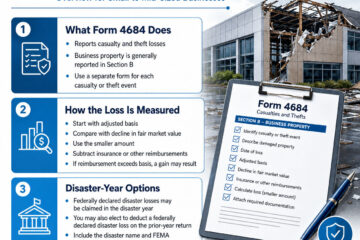
If the storms damaged your home, personal property, vehicle, business equipment, or inventory, you may be able to claim a casualty loss deduction. This applies whether you are an individual homeowner or a business owner. You can choose to claim the loss on your 2026 return or on your 2025 return by filing an amended return.
Claiming the loss on the earlier year can sometimes get you a faster refund. You will generally use Form 4684 and must reduce the loss by any insurance payment you received or expect to receive. You also need to include the FEMA disaster number, 4933 DR, on your return.
For a full walkthrough of this process, read our guide to claiming a casualty loss deduction on Form 4684.
How Serious Is Your Situation
Lower Concern
You are outside the FEMA declared counties and your state has not announced relief for your area. Keep filing and paying on your normal schedule, but watch for updates in case your county is added later.
Moderate Concern
You are inside a covered county but you are not sure which deadlines actually moved, or you have both Indiana and Illinois or Michigan filings to manage. Confirm your address on file with the IRS and review each state’s rules separately before you assume anything is automatic.
Higher Concern
You already missed a payment, received a penalty notice, or you have significant storm damage to claim as a casualty loss on your home or business. This situation needs attention right away. Call Simple Finances™ today so we can review your notice and your options before the penalty grows or a deadline passes.
Steps to Take Now
- Check whether your county is part of the FEMA disaster declaration.
- Confirm the address on file with the IRS matches your current business address.
- Mark February 1, 2027 as your new federal deadline if you are in a covered Indiana county.
- Review Illinois or Michigan rules separately if you operate in those states.
- Gather documentation on any storm damage in case you want to claim a casualty loss.
The IRS tax relief August 2026 storm extension Indiana, Illinois, Michigan can genuinely help every taxpayer this year, whether you file as an individual or a business. Guessing can cost you a penalty. Confirming takes one phone call.
If you are not sure whether you qualify, our team can also walk you through related topics like claiming a casualty loss deduction on Form 4684 and how our IRS representation services can support you if a notice arrives.
Call to Action
Do not wait for a penalty notice to find out which deadline applies to you. Schedule your IRS Resolution Discovery Call with Simple Finances™ today and we will confirm exactly how the IRS tax relief August 2026 storm extension Indiana, Illinois, Michigan applies to you.