 Most small business owners know their pricing is too low. What they don’t have is a small business pricing strategy that tells them how far behind they are — or what to do about it.
They’ve probably known for a while, and they keep meaning to do something about it. But raising prices feels risky and raises too many “what if’s”. What if clients leave? What if competitors undercut them? What if the timing is wrong?
So, nothing changes. Every month, the gap grows between charges and actual business costs. And without a small business pricing strategy to check it against, there is no way to see how much room you actually have.
The Silent Pay Cut
When your costs go up and your prices stay flat, you are effectively cutting your own pay.
Inflation is the problem. Fuel costs more. Labor costs more. Software subscriptions renew at higher rates. Insurance premiums increase. Rent goes up and the list goes on. But your pricing has not.
The business looks the same from the outside while the profit margin is quietly shrinking from the inside.
This does not show up dramatically. It feels like a slow tightening. Each month, there’s less cushion. You face more pressure at tax time. And your bank balance doesn’t match your workload.
What Your Prices Need to Cover
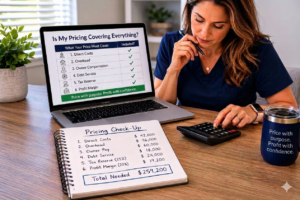
A sustainable small business pricing strategy has to cover six things. And most owners only build two or three of them into their pricing.
- Direct costs. Materials, direct labor, subcontractors, and job-specific supplies.
- Overhead. Your proportionate share of rent, insurance, utilities, software, vehicles, and administrative costs.
- Owner compensation. The cost of your own labor, your pay through a salary, a draw, or both.
- Debt service. The monthly interest cost of any business loans or equipment financing.
- Tax reserve. A percentage of revenue set aside for income taxes throughout the year.
- Profit margin. The return on your investment and the risk you carry as the owner.
If your price does not cover all six, you are subsidizing your customers from your own resources. And while you may not feel it immediately, you will eventually.
How to Calculate Your Overhead Rate
 This is the calculation most small business owners have never done. And it changes how you think about pricing.
Calculate your total annual overhead. This covers all fixed costs not directly linked to providing a specific product or service. Rent, insurance, utilities, software, administrative staff, vehicles used for general business.
Divide that number by your annual billable hours or units of service.
That is your overhead rate per billable hour or unit. It has to be in your price before you earn a single dollar of net profit — and this is the step most business owners skip.
Because they tend to price around direct costs, then hope what is left covers everything else. But overhead does not wait its turn. Rent is due whether you billed 20 hours or 40. Software renews whether the month was slow or full. If overhead is not built into the price itself, it gets paid out of profits. And this continues quietly, every month, until the gross profit margin grows narrower.
Here is an example. If your yearly overhead is $96,000 and you provide 2,000 billable hours, your overhead rate is $48 for each hour. That $48 must be in every price you set — on top of your direct costs and before any margin.
Most business owners who run this number for the first time find their current pricing does not cover it.
The Price Increase Most Business Owners Are Afraid to Make
Many business owners fear losing clients, so they avoid raising prices.
Research backs up some of that fear — but not as much as most owners assume.
A Federal Reserve Bank of Richmond study of retail pricing found that a 1% price increase raised annual customer turnover from about 14% to 21%. In plain terms: out of 100 clients, you might lose roughly seven more in a year than you would have without the increase. (Source: Richmond Fed, “How Well Do Firms Retain Customers After Price Increases?” 2023)
That is a real effect but it is also a small price move, and it is not the same for every client. Longer-tenured clients tend to absorb price increases better than newer ones. In service businesses, loyal clients are usually more forgiving of a moderate increase than clients who have not been with you long.
So the retention hit from a price increase usually has less to do with the percentage itself and more to do with how clearly clients see the value, how long they have been with you, and how the increase is communicated.
And, the clients most likely to leave over a price increase also tend to be the most price-sensitive and often the least profitable to serve. The best way to decide, is to model it before you make the change. The math usually tells a different story than the anxiety does.
A Simple Pricing Check You Can Do This Week
Pull your last 12 months of financials. Find your gross profit margin — revenue minus direct costs, divided by revenue.
If that margin is below 35% in a service business, pricing is likely part of the problem.
Then run the overhead calculation above. Compare your overhead rate to what you are currently building into your prices.
If there is a gap, you have found part of the answer.
When to Bring in a Financial Professional
If your margin analysis leaves you with more questions, or if you want to test a price increase, a fractional CFO can help you build a small business pricing strategy that actually holds up.
That work takes one conversation, but the impact can run for years.
Take the Next Step
At Simple Finances™, we help small business owners who want to stop guessing build a small business pricing strategy that works. We break apart your financial reports to uncover the obstacles to your profits. And we break down the financial jargon into understandable information you can use.