 Most small business owners do not decide when to hire a bookkeeper on a calm afternoon. They decide it in a panic, three days before a tax deadline, staring at a shoebox of receipts. Or they use their bank balance in exchange for bookkeeping and that never goes well. But, it does not have to go that way.
This guide lays out the exact warning signs that mean it is time to bring in professional help. It also covers what a bookkeeper actually does, what the service costs, and what happens if you wait too long.
How a Bookkeeper Improves Your Business
A bookkeeper records your business transactions, reconciles your bank and credit card accounts, and keeps your financial statements accurate every month.
Your bookkeeper is the foundation your tax preparer, your lender, and your own decision-making all stand on. Bad bookkeeping does not just create a messy spreadsheet. It creates bad tax returns, bad loan applications, and bad business decisions.
7 Signs It Is Time to Hire a Bookkeeper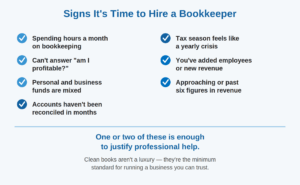
You do not need all seven signs to justify the move. One or two is enough.
1. You Spend More Than a Few Hours a Month on Books
Every hour you spend reconciling transactions is an hour you did not spend serving clients or generating revenue. Your time has a dollar value. Bookkeeping should not be the task eating it.
2. You Cannot Answer “Am I Profitable?” Without Guessing
If someone asked you right now whether last month was profitable, could you answer in under thirty seconds? If not, you are running the business blind.
3. Personal and Business Money Are Mixed Together
This is the single most common bookkeeping mistake small business owners make. It turns a simple tax return into a forensic project, and it puts your liability protection at risk if you operate as an LLC or S corp.
4. Reconciliation Has Not Happened in Months
Unreconciled accounts mean your reports cannot be trusted. Not by you, not by your tax preparer, not by a bank underwriting a loan.
5. Tax Season Feels Like a Crisis Every Year
If you dread the first week of the year because you know what is coming, that dread is a signal. Clean monthly books turn tax season into a formality instead of a fire drill.
6. You Have Added Employees, Contractors, or a Second Revenue Stream
Complexity multiplies fast. Payroll, contractor payments, and multiple income streams all add categories, deadlines, and compliance requirements that outgrow a simple spreadsheet quickly.
7. You Have Crossed — or Are Approaching — Six Figures in Revenue
Somewhere around this point, transaction volume outpaces what one person can track accurately in spare time. This is not a hard rule. It is a pattern that shows up again and again.
Self-Diagnose: How Urgent Is Your Situation?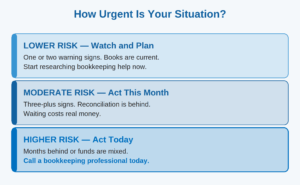
Not every business needs a bookkeeper tomorrow. Some need one this week. Use this framework to pinpoint when to hire a bookkeeper.
Lower Risk — Watch and plan. You have one or two warning signs, your books are current, and tax season did not cause panic last year. Start researching bookkeeping services now, but there is no fire to put out.
Moderate Risk — Act this month. You have three or more warning signs, reconciliation is behind by weeks, or you are guessing at profitability. Waiting will cost you real money in missed deductions and bad decisions.
Higher Risk — Act today. You are behind by months, personal and business funds are mixed, or a tax deadline is close and your records are not ready. At this level, every week of delay adds cleanup cost and audit risk. Call a bookkeeping professional today.
What a Bookkeeper Costs
Bookkeeping pricing depends on transaction volume, entity complexity, and whether payroll is involved. Monthly bookkeeping services for small businesses commonly range from a few hundred dollars a month for simpler operations to more for businesses with payroll, multiple accounts, or high transaction volume.
The right way to think about cost is not “what does a bookkeeper charge.” It is “what does not having one already cost me.” Missed deductions, late penalties, and rushed cleanup work routinely cost more than a year of proactive bookkeeping.
What Not to Do While You Decide
- Do not keep mixing personal and business accounts while you “figure it out.”
- Do not wait until the IRS or your state sends a notice.
- Do not assume your accounting software is doing the job of a bookkeeper. Software records data. A bookkeeper makes sure that data is correct.
- Do not let a backlog grow past a few months before asking for help.
Clean books are not a luxury. They are the minimum standard for running a business you can trust.
Do It Yourself or Hire a Professional?
Deciding when to hire a bookkeeper often comes down to a trade-off. DIY bookkeeping can work for a very early-stage business with simple, low-volume transactions and no employees. It starts breaking down once you add a second revenue stream, hire your first contractor, or approach six-figure revenue.
At that point, the question is not whether to get help. It is how much the delay has already cost you.
Why This Matters Beyond Tax Season
Clean, current bookkeeping is not just about filing an accurate return once a year. It tells you whether a new hire made you more money or just more expensive. It tells you whether a slow month is a trend or a fluke. It is the data behind every confident decision you make.
Simple Finances™ works with small business owners, individual taxpayers, and nurse entrepreneurs who need bookkeeping they can trust and advisors who understand both the numbers and the tax consequences behind them. Our team is built on Enrolled Agent-level tax expertise combined with hands-on bookkeeping and advisory experience.
Stop guessing about your numbers. If you are still weighing when to hire a bookkeeper, a short consultation can give you a clear answer.