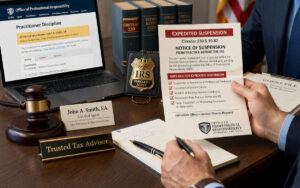
 Many tax professionals know the rules of Circular 230, but many business owners do not and trust that their tax advisor follows them. And understanding the seriousness of the expedited suspension rule is vital for business owners and tax professionals to stay IRS compliant.
Under this rule, the government may stop a practitioner from representing clients before the Internal Revenue Service much sooner than most people expect. This is not the long and slow discipline process that many people picture. It is a quicker path used in serious cases when the government believes clients or the tax system may be at risk.
That matters to clients because hiring a tax professional is not only about tax preparation. It is also about judgment, trust, and the ability to stand beside a client when trouble starts.
If that right is taken away, the client may lose support at the worst possible time.
What Expedited Suspension Means
Expedited suspension is a rule under section 10.82 of Circular 230, the IRS rules for tax professionals. It allows the government to suspend a practitioner before the Internal Revenue Service after notice and a chance to answer.
The key point is simple. The government does not always wait for a long hearing before it acts.
A practitioner still has a chance to reply, but the timeline is short and the risk is high. That is why business owners should understand the rule, even if they never read Circular 230.
Main Reasons the Government May Act
Circular 230 lists specific reasons for the expedited suspension. These are serious matters, not small mistakes or routine disputes. Here are some examples.
Loss of a Professional License
A practitioner may face expedited suspension if a state board, federal agency, or federal court suspended or revoked that person’s professional license for cause.
That matters because practice before the Internal Revenue Service depends on trust and fitness. If another authority has already found serious misconduct, the government may decide that waiting is not wise.
Conviction of Certain Crimes
A practitioner may also face suspension after conviction of certain crimes. These can include federal tax crimes, crimes involving dishonesty, crimes involving breach of trust, and certain felonies that show the person is not fit to practice.
This point is important because conduct outside their tax work can still affect the right to represent taxpayers.
Failure to Follow Prior Discipline Terms
Sometimes a practitioner was already disciplined in an earlier matter. If that person then fails to follow the required terms, the government may act again.
This shows that an earlier case does not end the risk when a person ignores the conditions that were imposed.
Certain Court Sanctions
A court sanction in a tax case may also support an expedited suspension. This may involve delay tactics, weak arguments with no legal merit, or failure to use available administrative steps before going to court.
Repeated Failure to File Tax Returns
In this example, a practitioner may face an expedited suspension for repeated failure to file required federal tax returns. That point is easy to understand. A tax professional who represents taxpayers should stay current on personal tax duties.
How the Case Starts
The case begins with an order to show cause.
This is a formal notice. It explains why the government believes suspension may be justified. It also gives the practitioner a limited period to answer and request a conference.
This is not a casual warning letter. It is a serious notice with serious consequences.
The short response period matters because it gives the practitioner little time to gather records, explain the facts, answer the claims, and try to stop the suspension from going forward.
Silence can make the problem worse. Delay can make it worse too.
What Can Happen Next
Many people assume that a full hearing must happen before a suspension takes effect. This assumption is wrong.
The suspension may come first, while a longer case follows later.
A suspended practitioner may ask for a formal proceeding before an administrative law judge. Even so, that does not erase the practical harm that may already be underway. Clients may still face delays, extra cost, and the burden of finding new representation.
A later complaint may also include more claims than the first notice. What begins as one narrow issue can grow into a broader review of the practitioner’s conduct.
And return to practice is not automatic. The government may look at future compliance, public protection, and whether the person can be trusted to practice again.
Why This Matters to Individuals and Business Owners
Some people think this is only a problem for tax professionals. But that is not true because clients can feel the effect of the expedited suspension immediately!
If your tax advisor loses the right to practice before the Internal Revenue Service, that person may no longer be able to represent you in an audit, collection matter, appeal, or other active case. Your work may stall. Another advisor may need to take over. Files may need to be transferred. And these all lead to added costs and stress.
That is why this issue matters in tax advisory services. A client is not just paying for forms and numbers. They are relying on the advisor’s conduct, standing, and ability to act on your behalf with the Internal Revenue Service.
When you hire a firm for resolution and advisory, you want reliability and judgment. And you want a professional who can represent you properly if a tax matter gets serious. You want a firm that takes compliance seriously on both sides of the desk.
That is why credentials, conduct, and professional standards matter.
At Simple Finances, we believe tax representation should be built on competence, honesty, discipline, and clear thinking. Those are not slogans. They are operating standards.
Conclusion
Expedited suspension under Circular 230 matters because it can remove a practitioner’s right to represent clients before the Internal Revenue Service in a short period of time. It may arise from license problems, fraud, court sanctions, failure to follow prior discipline terms, or repeated failure to file tax returns.
For business owners, the lesson is clear and a reminder to work with advisors who take their responsibilities seriously. The right advisor should offer reliability, discipline, and trustworthy support for all tax matters.
Contact us if you have questions or need tax resolution or advisory support.